Announcement

Collapse
No announcement yet.

Target Reflection

Collapse
X
 
  • Filter
  • Time
  • Show
Clear All
new posts

  • Target Reflection

    Anybody know about target reflection? Bob Fitzgerald units have what he calls TRN target Reflection Nullifier. Tim Williams has what he calls TV Target Verify which he says to see if signal is a reflection.

    For metal detectors, the process is to cancel a part of the received signal. It's not done during transmission. Anybody?

    The reflection component is in real time. Well, I don't know but it seems illogical to be able to cancel something at the exact same time it is sent out. Something does not seem right.

    I am waiting to be enlightened.
  • #2
    I'm not saying it can't be done. I am asking how.

    Comment


    • #3
      Why you need to cancel signal reflected from target?

      Such signal is what we are asking for. It identified hidden target.

      But if you need to separate transmitted signal from reflected signal, there are different ways.

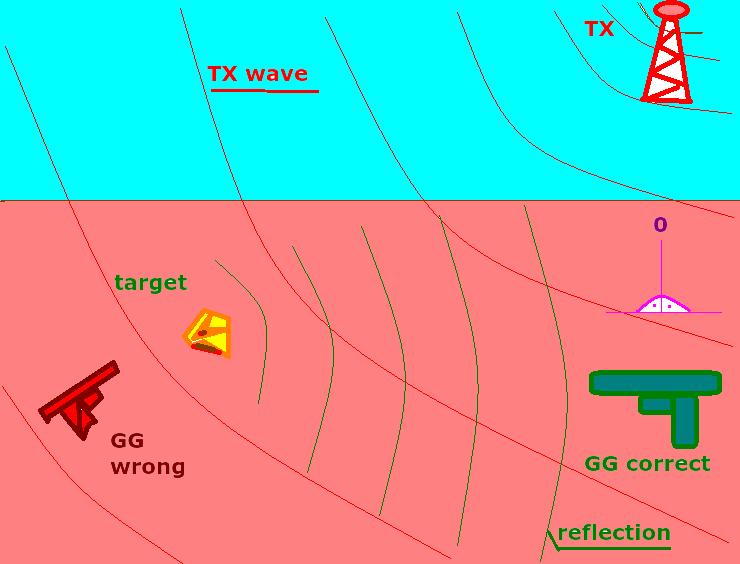
      One most simple is to have very directive receiving antenna (usually long ferrite A) and search at constant angle to transmitted signal, at which (angle) transmitted signal does no more direct disturb receiver. In rule such angle is (with pointing ferrite antenna) at 90° to transmitted signal direction.

      Another way is to compare phase of transmitted and reflected signal and filter unwanted part out. Reflected signals are always phase shifted in regard to phase of transmitted signal. This is problem much like problems with MD discrimination solution design.


      Mentioned Simple solution (can be used to tune and use Gold Gun too):

      Global capital is ruining your life?
      You have right to self-defence!

      Comment


      • #4
        I think you missed the point. The LRL's that Fitzgerald and Williams sell do not have an electronic receiver so received signal cannot be "worked on". Whatever reflection they "nullify" would have to be accomplished during the transmit stage.

        I know Carl did a "Report" on the Mini-Eliminator II. I wonder if he put it on a spectrum analyzer? Pretty sure he could describe what he sees better than I could. I did look at it, but don't recall that much about how the signal changes when the TRN is turned on. Well, I might see if I can get the spectrum software running again and if so I will post the results. In the mean time, maybe Carl can chime in here.

        Comment


        • #5
          Okay, let's try a different approach. There are two components to a received signal--the reactive and the resistive. The reactive component is the reflection part and it happens at the exact same time as the transmitted signal. It appears the claims are the TRN and TV can somehow eliminate this reactive reflection by doing something to the transmitted signal. And this is what puzzles me.

          Comment


          • #6
            Mike, talking about LRL with rods, you have to think diferent. It is a known problem for decades, with several names and also several approaches to solve it.
            In a LRL with rod's, the problem is the "human receiver" : very unreliable.
            If you manage to change the sensitivity of the user/receiver, then you will see that the signal line between generator and target, will also change.
            Humans responde to the rate of change, rather to the absolute maximum value of this strange field.
            Note that the dynamic range differs from user to user, as also the minimum/ maximum rate of change, that a human receiver can see.
            So, in the case of an "old" massive target, we talking about an endlles chaos of local minima/maxima at wich usually a human receiver respond.
            There are some (partially) solutions wich work well enough, if you deal will relative small /medium targets.

            Comment


            • #7
              Yes, I kinda think they are trying to compare an LRL response to a metal detector response. But the metal detector received signal has been processed to remove parts of the signal like with ground balancing. Of course the L-rods can't do that. So somehow the LRL transmitted signal is altered to "nullify" this?

              I am trying to get spectrum lab working again. I messed up and got all excited and reset everything back to factory. Now I can't get it to work very good. Especially the frequency span. It's because the external microphone i am using is a 24 bit 96000 Hz. If anyone knows how to configure the Spectrum Lab to this microphone I would appreciate any help. This external sound card is SD-AUD20101

              Comment


              • #8
                Made some progress with the Spectrum Lab, but something is still not working right. Will have to do more checking.

                Comment


                • #9
                  Still can't get the Spectrum Lab working like I had it. And the harmonics around here are not good. So maybe I'll try it outdoors after I get it figured out a little better. You know, in a year or so. I don't know why I am screwing with this thing. Kinda like how a one year anniversary can bring back trauma. Guess I'm still frustrated over it. I don't know why.

                  Comment


                  • #10
                    My spectrum analyzer is a bit unconventional. I use a SuperSID monitor I got from Stanford.edu (think I paid $60 or something) and built a coil maybe about 30 inches square with magnet wire. Can't recall how many turns (400 feet of wire), but whatever they say in the instruction manual on-line. Then I run this through the Spectrum Lab software. Since my laptop does not have an internal sound card I got the SD-AUD20101 which has 24 bit 96 kHz. You can get by with less if you don't want the higher frequencies, but it's cheap enough. Anyway I just place the LRL near the coil in line with the windings. There are other DIY SID monitors on line. I was going to build the Gyrator III. Got the board but...

                    Comment


                    • #11
                      attempt to post photo
                      This is the Mini-Eliminator with TRN on
                      set to 18kHz

                      You can also see some VLF stations at 21 something 24.8 and 25.2
                      Attached Files

                      Comment


                      • #12
                        This is a VLF metal detector at 18kHz
                        Note harmonics
                        Attached Files

                        Comment


                        • #13
                          First photo ME-II on SID software
                          Second photo VLF metal detector
                          both at 18kHz
                          Attached Files

                          Comment


                          • #14
                            I don't know if those are harmonics because they are not in multiples of the main frequency. It's hard to see exactly what is on the SID software because it adjusts the scale automatically.

                            There are other VLF stations there, too. Check the frequencies. Hawaii, Iceland.

                            Comment


                            • #15
                              Mike, you already know my answer. Reflection nullifiers, ghost signals eliminators, weight checks... they're all alibis for products that don't work in the first place, and excuses for selling equally worthless add-ons to gullible people who haven't figured out they were taken by the initial sale.

                              The ME-II TRN is a good example. It's a "feature" that does absolutely nothing. Since the dowsing response is all in the mind, the user might pretend that it does something, by imagining a difference in the dowsing response depending on whether TRN is on or off. But the end result is the same; the ME-II ain't gonna locate anything, TRN or no TRN. Even the battery is optional.

                              Compare to a metal detector ground balance. Turn it off, and the detector responds to ground. Turn it on, and you can find a setting where the response is nulled. It does something, and that something is measurable and can be agreed upon by everyone who uses it.

                              But let's suppose for a second that the GB knob was not connected to anything in the metal detector circuit. No matter where you set it, the detector has the same ground response. It would be pretty obvious to any user that it doesn't do anything, because they are using a device that fundamentally works in the first place. With LRLs, all those knobs and switches don't have to actually do anything, and no one would ever know. Very often that's the case.
                              Last edited by Carl-NC; 11-12-2017, 09:41 PM.

                              Comment

                              Working...
                              X