
 Tweet
Tweet
Originally posted by Geo
View Post
Maybe you are talking about a different kind of detection than I show above.
I show the photo of MFD equipment which is said to produce a signal line again:
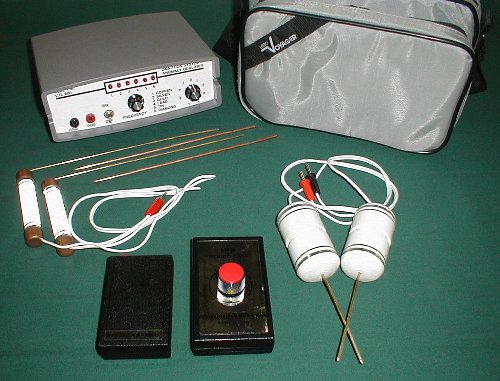
I am talking about the LRL which you see in the photo, not about an LRL that uses a ferrite receiver.
For this LRL the MFD generator is connected to the ground probes and placed in the ground.
Then a signal line is established between the ground probes and the buried metal.
The treasure hunter with dowsing rods walks until he finds where this signal line is.
The signal line does not move when the treasure hunter moves.
The signal line does not follow his rods.
He uses his rods only to find where is the signal line.
Then he follows the invisible signal line through the air until he finds the end where the buried metal is.
He does not use his rods like a radio direction finder.
He has no ferrites to find a null.
He only looks for the invisible signal line that is a single line between the ground probes and the buried metal.
You can read where Carl-NC explains -- "A "signal line" is established between the transmitter and the target, and the dowsing rods are used to detect and track the signal line."
Read here in the beginning: http://www.geotech1.com/cgi-bin/page...r800/index.dat
You will also find that other people who use and sell MFD locators say the same as Carl-NC.
Dell winders, Mike(Mont), and others who use the equipment you see in my photo say that MFD signal line remains in one single line between the transmitter ground probes and the buried metal.
Then they use dowsing rods to find this line in the air.
You can read the instruction manual for the Vernell VR-800 MFD locator here: http://www.vernellelectronics.com/VR...0%20MANUAL.doc
This manual also tells that you need to find the signal line between the transmitter and the buried metal by using dowsing rods to find it.
Vernell is the company who manufactured the locator you see in the photo above.
If you are talking about an LRL which uses an electronic ferrite receiver with no dowsing rods, then you are not talking about the same equipment you see in my photo which uses dowsing rods to find the signal line.
You are talking about an all-electronic LRL.
Ferrite LRLs do look to find the same signal line as MFD like you see in the photo.
Ferrite LRLs work on the theory of radio direction finding.
There is no signal line to be found with all-electronic ferrite LRLs.
All electric LRLs look for simple radio direction finding null or maximum.
The signal line is only for LRL which has a swivel or dowsing rod.
This section of the forum is only for the MFD LRLs which use a dowsing rod.
If you want to talk about ferrite detectors that do not use dowsing rods, and do not use signal lines, then you should make your post in the other forum section that is for all-electronic LRLs: All-Electronic LRLs
Best wishes,

J_P
Comment