

 Tweet
Tweet
Mike , finally at what range are the operating frequences of the Magnacast 5000? Looking the coil i assume that are at the audio range (or not?).
-
-
Can't help you with that one, Bill. My frequency counter will not register, but an AM radio will pick up a tone that is obviously in the audio range. Quite a while back Dell talked about HID units operating in three different frequencies. I'd have to go back and check on it. I've seen ads from Asia that mention (pirated units?) 4-400 MHz and another mentions ultrasonic range.
"...The only instruments on the market that fully discriminate are the H.I.D. (Harmonic induction discrimination) These transmit & receive (3) timed, synchronized signals that respond to the Electron, Neutron, and Atomic Weight of the element. All other instruments on the market respond to the Electron only."Comment
-
Also known as "Continually Replenished Alternating Potential".Originally posted by Mike(Mont) View Post
Comment
-
 Dear J Player and Mike,
thank you for your replies.
Mike, I notice that you have put quite an effort and time to learn your Magnacast 5000. May I ask: have you ever tried it on a big target at a serious distance away ??? say 300m. 500 m. ?
Have you felt the difference between a buried target and a visible metalic object on the ground [ say a car...] Does it respond to the unburied target as well...???
Your answer will be a great help, dear friend.
Kind regards,
AlexComment
-
I have never used a Magnacast 5000.Originally posted by ALEX.356
I have no idea what a Magnacast 5000 does in the field.
My basis for determining what to expect from a Magnacast 5000 is seated in the reports I have read that describe the internal components. ie: An op amp without a power amplifier broadcasting an unknown frequency alleged to be in the UHF range, and a coil receiver used to survey a plot of land where a variety of specific metals might be buried.
From what I have learned, more broadcast power would be necessary, and a method of discriminating metals would also be necessary, which does not seem to be present in the electronics of the Magnacast 5000.
Based on pure interpretation of the advertising propaganda for the Magnacast 5000, I would speculate that at best, there exists a scanner chip in the circuitry that jumps to different frequencies, like to a broadcast scanner that will lock onto any strong signal as it scans, and hold that frequency until it becomes weak. Then it would jump to the next frequency until it finds another signal above the threshold. But I could be wrong about this. It is only speculation that they upgraded the 555 timer/oscillator to operate in a frequency scanning mode after the scanner chips became available for a cheap price.
The idea to actually test a Magnacast 5000 in the field seems to me like a waste of time for two reasons:
1. The people who manufacture the Magnacast 5000 (Vernell Electronics) has a long history of producing products that do not show substantial results for the people who use these products.* This means that people who use metal detectors are known to show recovered treasures in amounts that total thousands of times more than what users of Vernell Electronics products show.
2. The electronic circuits that have been shown from disected Vernell products appear to be extremely ameteurish in their design and in their construction. After seeing photos of the inside of a VR-800, I would not pay more than $20 US for any Vernell Electronics product. The only reason it may be worth $20 to me is for museum display value -- not to find treasure.
The simple answer to your question is no. I have not used the Magnacast 5000.
The more pertinent answer is:
If I believed that I could detect the location of hidden metals by broadcasting RF and surveying a field with a loop antenna, then I would build a viable RF transmitter that had a wide beam angle, and I would build a sensitive receiver with a suitable size receiver coil to survey the area where I thought the metal is hidden. Remember, the Vernell transmitters I have seen so far use a single op amp oscillator with the output pin connected to either a metal rod stuck in the ground, or a small antenna set on the ground.
If you thought this theory worked, wouldn't you prefer to use a real transmitter?
Best wishes,
J_PComment
-
J_P
Dear friend,
I appreciate the time you take to answer my questions.
" wouldn't I prefer to use a real transmitter" . . .?
Yes , I would.
Obviously you are making a hint that Magnacast 5000 in NOT a real transmitter. . . As I am not in a position to know...I ask what is the output of this transmitter ? Isn't it written in the manual ?
What would you consider enough output in such a case ?
I do take seriously what Mike says about it , that it is perhaps 50-100 times stronger than the MFD s he has tested. Kindly comment on this.
Cordial regards,
ALEX.Comment
-
From what I have read, the Magnacast 5000 is similar to the other MFDs that are manufactured by Vernell Electronics, and is a simple variation of the theme. It is hard for me to believe any of the Vernell equipment can work because there is not a single incidence of someone demonstrating it locating unknown treasures in front of witnesses.
But the best evidence I have that the transmitter is simply a signal generator with no power amplifier or tuning coil is the circuit diagram shown by Carl NC when he opened the VR-800 MFD (a similar MFD manufactured by Vernell). This was a predecessor to the Magnacast 5000 which also is claimed to work on the same "forward gauss" detection principle as the other MFDs that Vernell manufactures. The difference is the 5000 comes with the coil receiver instead of L rods to scan the field. See Carl's report for the VR 800 here: http://www.geotech1.com/cgi-bin/page...r800/index.dat
Here is the VR 800 circuit. Do you think you can broadcast an RF signal if you connect Vout to a rod stuck in the ground, or to a small antenna set on the ground?
Wouldn't a real transmitter work better, even if it is only a cheap $10 pocket transmitter?
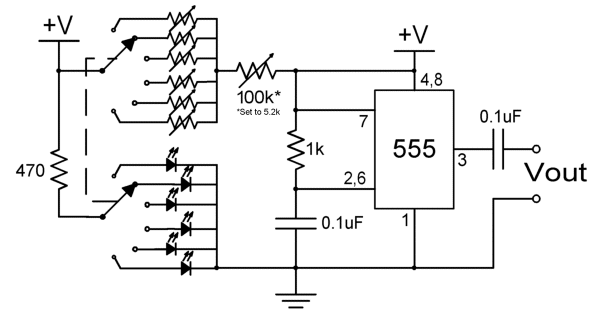
A close look at the circuit will show there is no RF power stage or tuning coils. This circuit is a simple square wave signal generator that is optimized to create a product that can switch on lights for a nameplate that says copper, gold, silver lead, tin and diamond. If you wanted a circuit that does this, can't you build the exact same circuit for less than $5?
Do you really believe the Magnacast 5000 has high tech circuitry inside and a real transmitter?
Why not open one and see what's inside?
Do you think you will find what everyone else found inside the Vernell products?
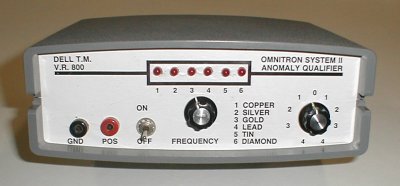
More evidence came when Dell Winders had something to say about the Vernell locator concerning his failure to win the Randi prize by locating coins hidden in the sand:But looking at the circuit, my opinion is conditions never existed that would make any Vernell product practical for use by anyone except a rich person who wanted a plastic box with 6 leds on the front, or a child who wanted a toy to play with.Originally posted by Dell Winders
Best wishes,
J_PComment
-
J_P
My friend ,
you oblige me with all your effort to assist me.
Question : Has anyone else attempted to make a similar devise on a more serious basis ? i.e with a real transmitter and directional receiver ?
Kind regards,
ALEXComment
-
Hi Alex.Originally posted by ALEX.356 View Post
There is a problem with the directional receiver. It must have very-very narrow bandwidth so to minimise the noise
Regards
GeoComment
-
GEO
and is it so difficult to acomplish , my friend ? [ narrow bandwidth ]
ALEX.Comment
-
The method of using a loop antenna to survey an area that is exposed to RF is a standard way that geologists determine what is under the ground. They carry a hand-held loop antenna connected to their receiver while they walk across the area they want to survey. The transmitter is usually a large VLF transmitter hundreds of miles away operated by the military or some government which broadcasts at a frequency between 5 KHz to 30 Khz, or sometimes higher. If there is no reliable VLF transmitter nearby, then the geologist may set up his own portable VLF transmitter to send RF into the ground for his survey. When the geologist is done recording the readings of his survey, he can make a map to show a diagram of the geological structures beneath the soil. The geologist is interested in mapping rock formations and other geologic structures, not hunting treasure.Originally posted by ALEX.356
This geologist's method is the basis for the idea that treasure hunters use for detecting metals under the ground when using an RF receiver coil survey. Early experimenters set up loop antenna transmitters and used loop receiver coils to find large buried metal objects a century ago. Today, experimenters have built detectors in various configurations that send out VLF signals and check the signal with a loop coil receiver. You can find some technical information about how to do this in this thread: http://www.geotech1.com/forums/showthread.php?t=16216
In the second half of the thread, WM6 and Seden become involved to help with their knowledge from their experience in ameteur radio, and explain some important details about the equipment, frequencies and power needed to expect some response. You will also see others posted ideas which include a few experimental projects that are related to the loop coil survey method.
There are also some other threads that show more about this.
Best wishses,
J_PComment
-
5000
Mike; I am considering getting one of these units. A couple of questions, how well does it really locate, what was the effect of the modification, and how quick can you locate something from the point of getting out of the car?
thanks, <><> LTComment
-
Originally posted by ALEX.356 View Post
Simply, it is not so easy.
It is something like EMFAD but for small or medium size objects we need more sensitive device
Regards
GeoComment
-
I'll try to address a few issues here. First off I want to say the so-called "electronics experts" do not seem to understand how an MFD works. Either that or they are intentionally trying to muddy the waters. I have tried about forty times to get people to read the book "Supersensonics" by Christopher Hills. Instead of embracing the book and author (In my opinion Hills is the most knowledgable person on the entire subject.) you get people attacking his wife and calling him a crackpot among other things. I don't have time to go into detail about his, but I highly recommend the book to anyone who claims to have electronics knowledge. Very briefly, the signal line that develops in resonance with the target acts like a type of antenna. Of course with L-rods, the receiver is the human body, brain, nervous system, and consciousness necessary to "make sense" of it all. Even when using an electronic receiver, the person needs a brain and a few mental skills to interpret what is happening. Anyone who tries to compare this to a metal detector is either deceptive or --deleted--. You cannot compare the two.
When I gave the figure of fifty to one-hundred times more powerful, I have to admit this is only an estimate. I have not actually measured the output in wattage. What I did was to hold an AM radio near a frequency generator and approximate the distance I could receive the audible tone, then compared this with the Magnacast. I didn't actually even measure the distance, but it was somewhere in that range.
I haven't tried to detect large objects like cars from a distance, but I see no problems.
When I went to a city park, I set up the transmitter twice and used a metal detector at the point of intersection. To do everything properly according to the instructions, it can easily take an hour or more.
I also want to point out I am not a salesman. I have no idea what your abilities of learning to use this device are. I don't even use it the way the instructions recommend. I don't care to spend hours training someone "for the good of society". If you buy one and can't get it to work, I can give you a few pointers (go back and read some of my posts) but you are on your own. It's actually more complicated than using L-rods, and the emotional variable is not completely eliminated. If you have a negative outlook (skeptic) I would not recommend one. A skeptic can easily talk themself out of just about anything.
That's all I have for now.Comment
-
One more note here. For some stupid reason some people think that if a device works they are somehow guaranteed to find treasure. Well, that's just not the case. And blaming the device solves nothing.Comment
Comment